AI Code Review

Catch what AI wrote, before you commit it.

Run one command or press a button to review your uncommitted changes, one review angle at a time. Inspect what was sent, what came back, and how many tokens were used, right on your machine.

Free forever · Open-source CLI

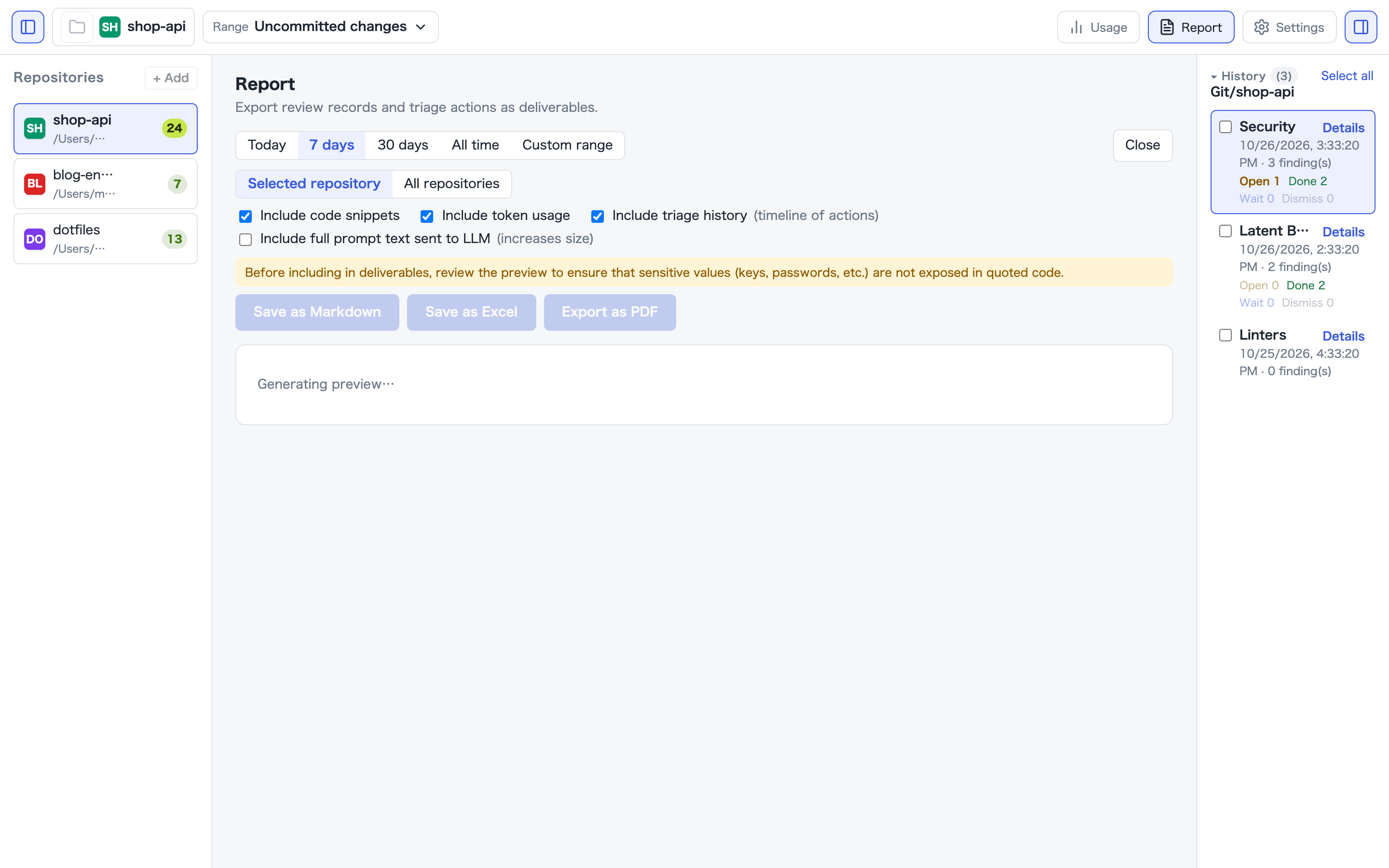
A MrCodeReview review result: six findings, already triaged, with what changed since the previous review

Features

Edit review angles · Add unlimited custom ones with CLI

Put a Markdown file with the same name as a built-in angle into .mrcodereview/recipes/ in your repository to replace that angle's wording. The whole file is the instruction sent to the AI. With the CLI (mrcr), you can also add unlimited custom angles simply by adding new Markdown files, and run them in terminals or CI/CD pipelines.

# .mrcodereview/recipes/security.md
# Our security review
Focus on authentication and on personal data written to logs.
(You can copy the built-in wording from "See what each angle sends" in the app)
Everything sent is visible

Before you run: the diff to be sent, and what is not sent and why. After: the full prompt, the raw response, and the measured token counts. You can always check what the AI was given.

The “Diff to send” panel: files included in the diff, and files that are excluded and why (a made-up repository)

Findings are checked against the diff

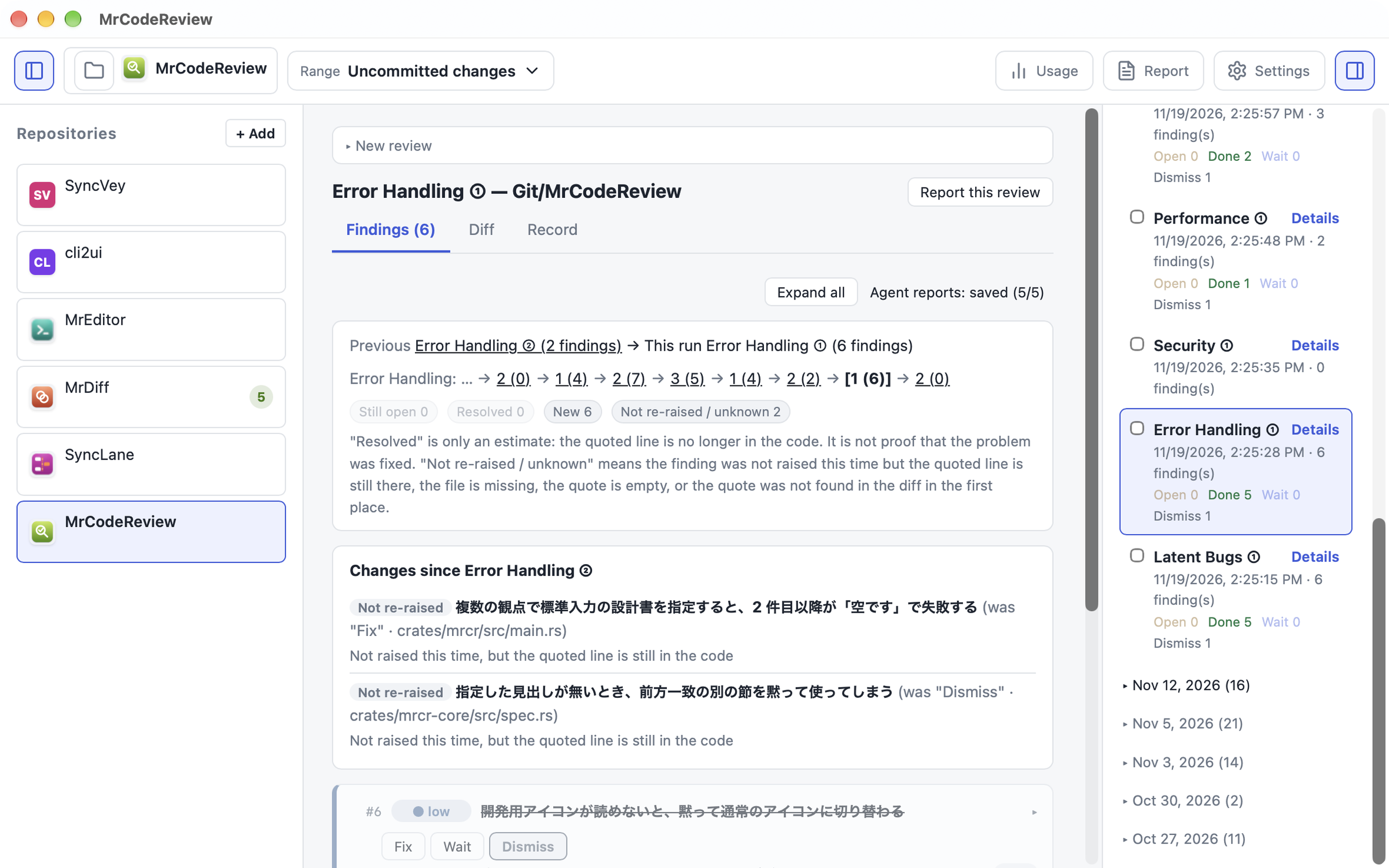
The line the model quoted is matched against the real diff and marked “evidence found” or “evidence mismatch”, so you don't spend time on claims about code that isn't there.

The findings list. Each has a severity and an explanation of how it breaks, and a finding whose quote is not in the diff is marked “evidence mismatch” (a made-up repository)

Two-way integration with coding agents (MCP)

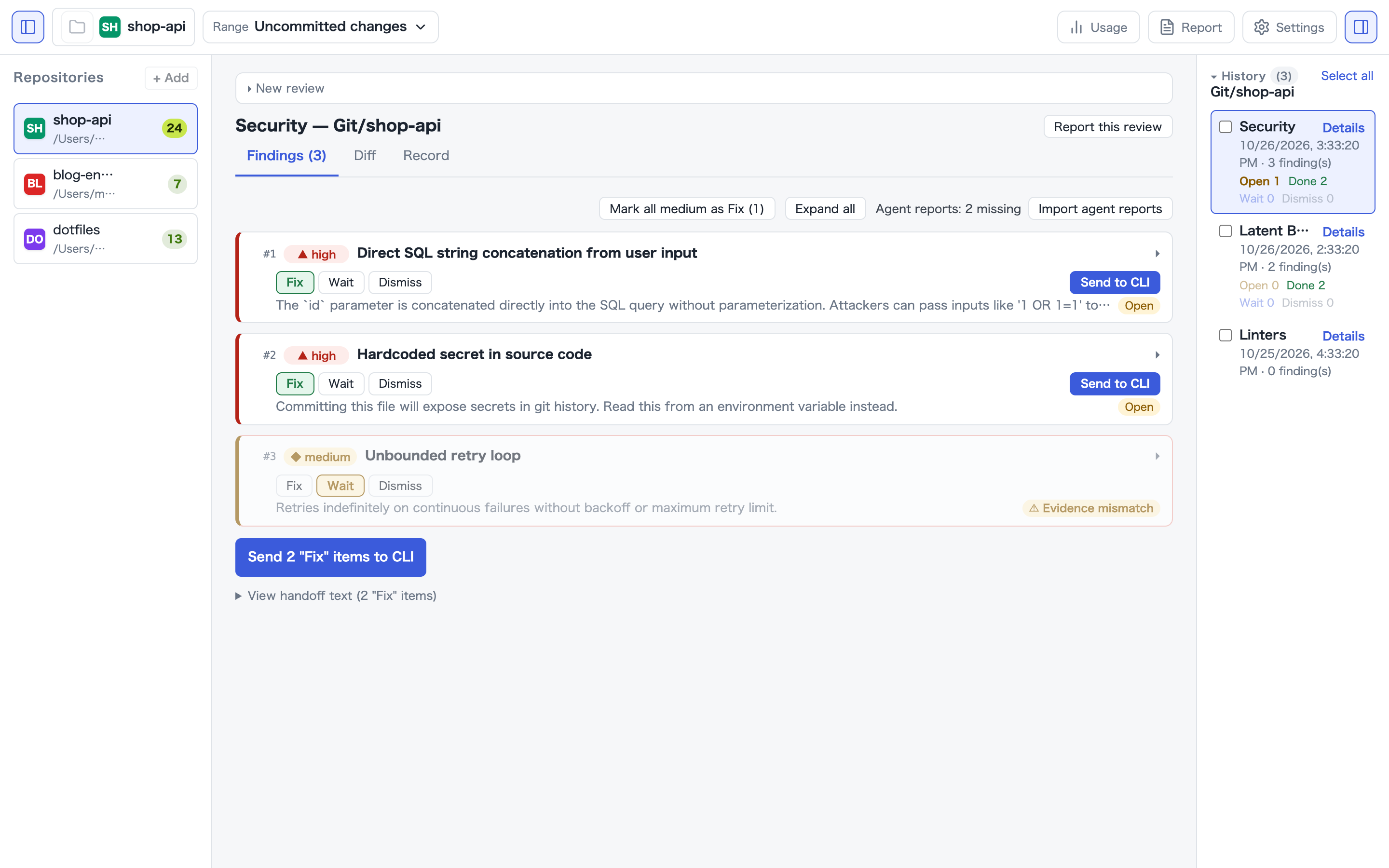
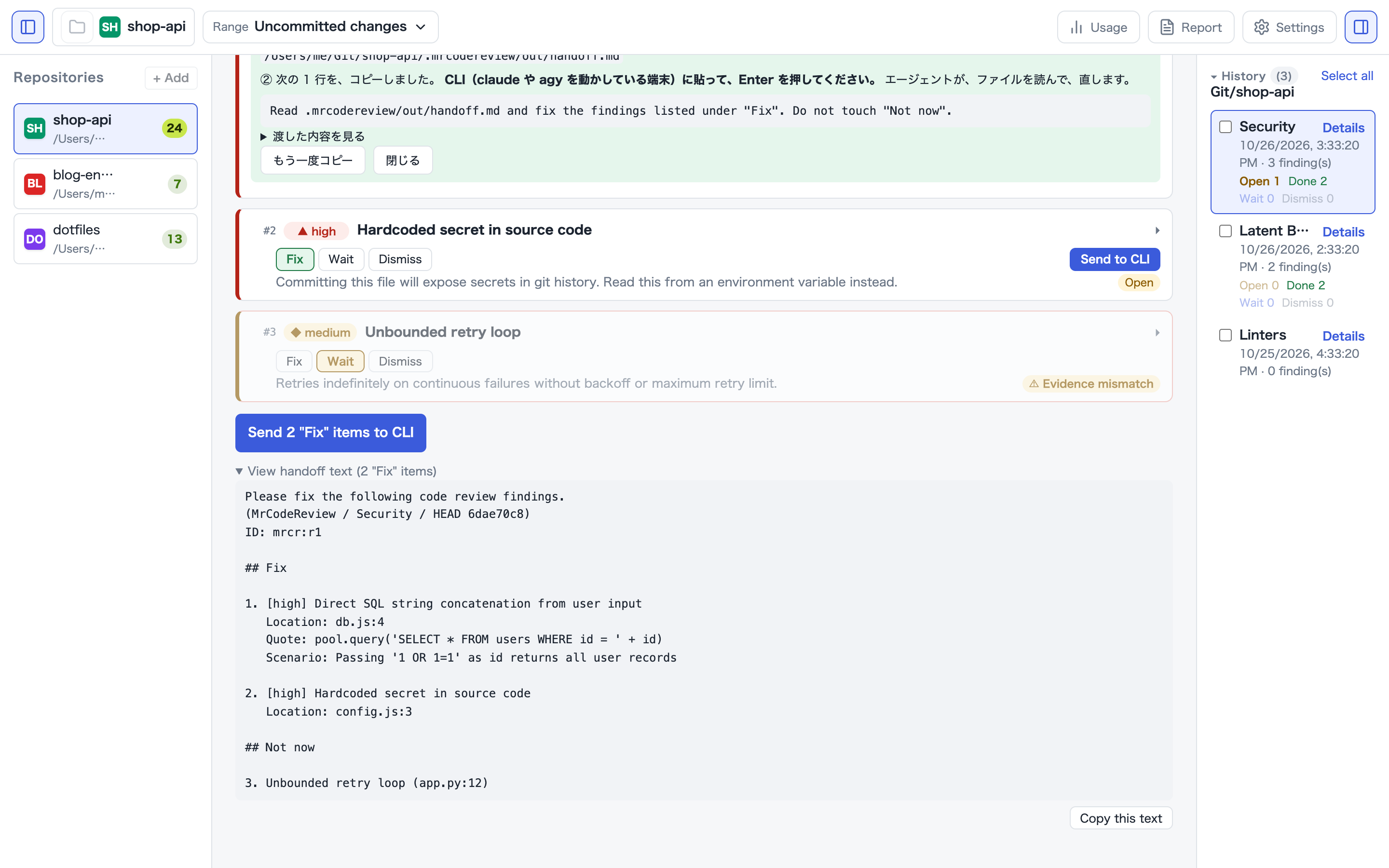
High and Medium findings are automatically triaged to Fix. With built-in Model Context Protocol (MCP) support, agents like Claude Code, Antigravity (agy), and Copilot read findings directly and record resolutions back to the database automatically—no manual import clicks needed.

Sharing triaged findings with coding agents (a made-up repository)

A record of what was done, as a report

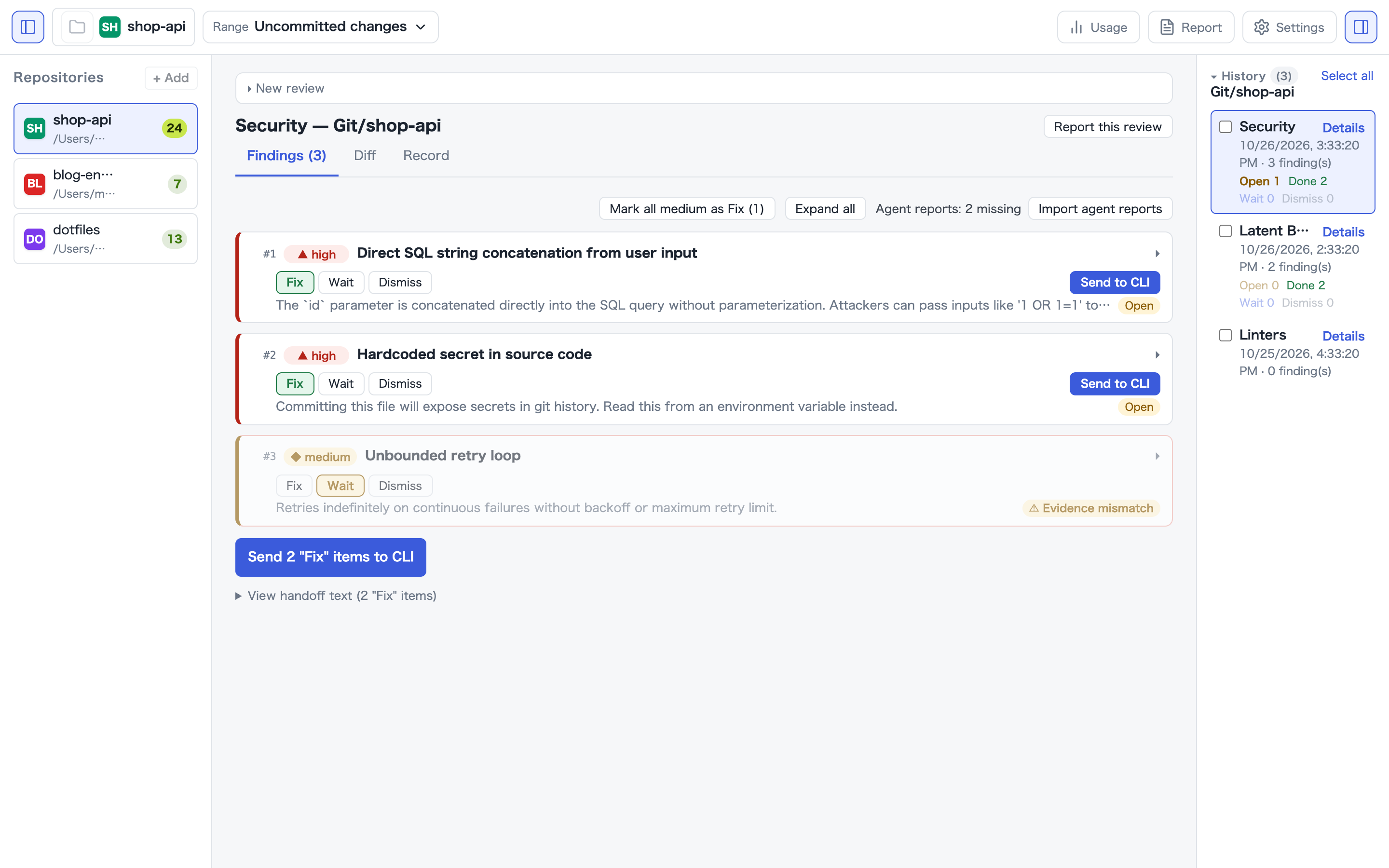
Export when, what, and how each finding was handled as Markdown, Excel, or PDF.

The report screen. Save as Markdown, Excel, or PDF (a made-up repository)

Your own API key, directly

No relay server (BYOK). The key lives in your environment variable or macOS Keychain, never in files. AI usage is billed to your own API account.

Compare against specifications & requirements

Select a specification file (.md / .txt) or paste requirements directly from GitHub Issues or Notion to verify that the changes comply with specifications. Supports narrowing down by section headings and verifies that quoted requirements actually exist in the document.

One review angle at a time

Code (latent bugs, error handling, security, performance, missing tests, cross-file inconsistencies, and spec compliance), Terraform (5 angles) and documents (4 angles: core, claims, reality, steps). You can edit the wording of each, per repository. Every finding must come with a concrete scenario of how it breaks.

Automatic review after each commit (Git hook)

Turn it on in the app (Settings → Git Hook) or with mrcr hook enable. After each commit, only that commit is reviewed in the background, one angle at a time, and the commit is never blocked. Results go into the normal history, and a run log shows which commit, which angles, how many findings, how long it took, and why an angle failed. Settings live in the app data folder, not in your repository. The hook calls the CLI, which reads the ANTHROPIC_API_KEY environment variable, and every commit calls the API once per selected angle (pay-as-you-go).

Linters run only when you allow them

Linters that execute the repository's code, such as ESLint and Clippy, run only for repositories you have explicitly allowed. You decide which repositories to trust.

Built-in review angles

15 angles, by category. The IDs are what you pass on the command line (for example mrcr review -r bugs,security). mrcr recipes lists them on your machine too.

Code (7)

IDLooks for
bugsCode that works now but breaks on specific input: off-by-one, null / empty handling, units and signs, wrong conditions, async races, unclosed resources, and more
errorsFailures that are swallowed, treated as success or made untraceable: empty catch, fallback values on error, unchecked return values, lost root cause, and more
securityInjection, missing authentication or authorization, hardcoded secrets, unvalidated input, crypto misuse
performanceCode that slows down as data grows: complexity, N+1 and I/O in loops, unbounded memory, blocking the UI thread, and more
testsChanged behavior not covered by tests in the diff: untested branches and failure paths, stale tests, weak assertions, and more
consistencyContradictions with code left untouched: callers of a changed signature, references to a renamed symbol, and more (uses related code outside the diff)
specContradictions between the diff and a specification or requirements doc: reversed requirements, missing implementations, or conflicting logic (supports file selection, direct paste, section targeting, and quote verification against the spec)

Terraform (5)

The app shows this group in the angle bar when the diff contains Terraform files (.tf, .tfvars, .hcl).

IDLooks for
tf-stateResource addresses and their mapping to state: count / for_each switches and key changes, renames without moved, import / removed mistakes
tf-replaceUnintended recreation or data loss: attributes that force replacement, misused lifecycle, apply-order downtime, deleting data-bearing resources without protection
tf-reproResults that differ across environments or time: missing or loose version constraints, lock-file drift, major bumps, timestamp() and "latest" lookups
tf-securityOverly broad IAM, public exposure (0.0.0.0/0, public buckets), disabled encryption or logging, hardcoded or non-sensitive secrets
tf-refsWhether variable, output and module references still connect across files and environments (uses related files outside the diff)

Documents (3)

For design notes, specs and READMEs. The app shows this group in the angle bar when the diff contains .md, .mdx, .txt or .rst files.

IDLooks for
doc-claimsNumbers, results or absolute statements ("always", "none", "unrelated") with no source, measurement, or account of how they were checked
doc-reality[Experimental] External command, package or API names, versions, prices or limits stated as fact with no sign they were checked. It can only say "needs checking"
doc-stepsGaps a reader cannot act on: missing preconditions, "decide later" used as if decided, decisions without reasons or a way back, contradicting status lines

Requirements and what it does

Only what works today is listed.

Requirements

  • Mac app (GUI): Apple Silicon Mac, macOS 13 or later
  • CLI (mrcr): macOS (Homebrew, or npx with Node.js 18 or later)
  • git (used to inspect repository diffs)
  • Git hook: needs the mrcr CLI (Homebrew, or npm i -g @mr-tabata/mrcr; a copy started with npx cannot be used)
  • An Anthropic API key (you provide it)

Working with coding agents

  • Two-way MCP integration: run `mrcr mcp setup` once, and agents like Claude Code, agy, and Copilot directly query and update findings without manual sync (it works with npx too)
  • File hand-off: outputs to .mrcodereview/out/review.md with prompt copying for any agent
  • Importing reports: also supports log imports (revocable anytime in settings)

When it uses the network

  • When you run a review: direct request to the Anthropic API
  • When the Git hook is ON: the same request after every commit, once per selected angle (the CLI called by the hook reads the ANTHROPIC_API_KEY environment variable)
  • When checking for updates in the GUI menu
  • No account, no analytics, no telemetry

What stays on your Mac

  • History, triage, notes and settings: local SQLite DB (shared between CLI and GUI)
  • Git hook settings and run log: the app data folder (hooks.json, hooks.log), never inside your repository
  • API key: macOS Keychain (GUI) or environment variable (CLI)
  • Hand-off files: .mrcodereview/out/ inside the repository (automatically gitignored)

Free and open source

MrCodeReview (CLI)

Catch what AI wrote before you commit it.

Free

Free forever · Open-source CLI

Open source (MIT License) · GitHub Releases

  • Review uncommitted diffs with 15 specialized angles (code, Terraform, documents, spec compliance)
  • Review automatically after each commit (Git hook; the commit is never blocked)
  • Add unlimited custom review angles with Markdown files
  • Detect hallucinations with strict quote verification
  • Hand off findings to coding agents (.mrcodereview/out/review.md)
  • Works in terminals and CI/CD pipelines
  • Install via Homebrew (brew install mr-tabata/tap/mrcr)
  • macOS support (Apple Silicon / Intel Universal)
Download MrCodeReviewView on GitHub

Start with the free MrCodeReview CLI.

brew install mr-tabata/tap/mrcr mrcr review # or without installing (macOS, Node.js 18+; pin the version) npx @mr-tabata/mrcr@1.13.0 review